

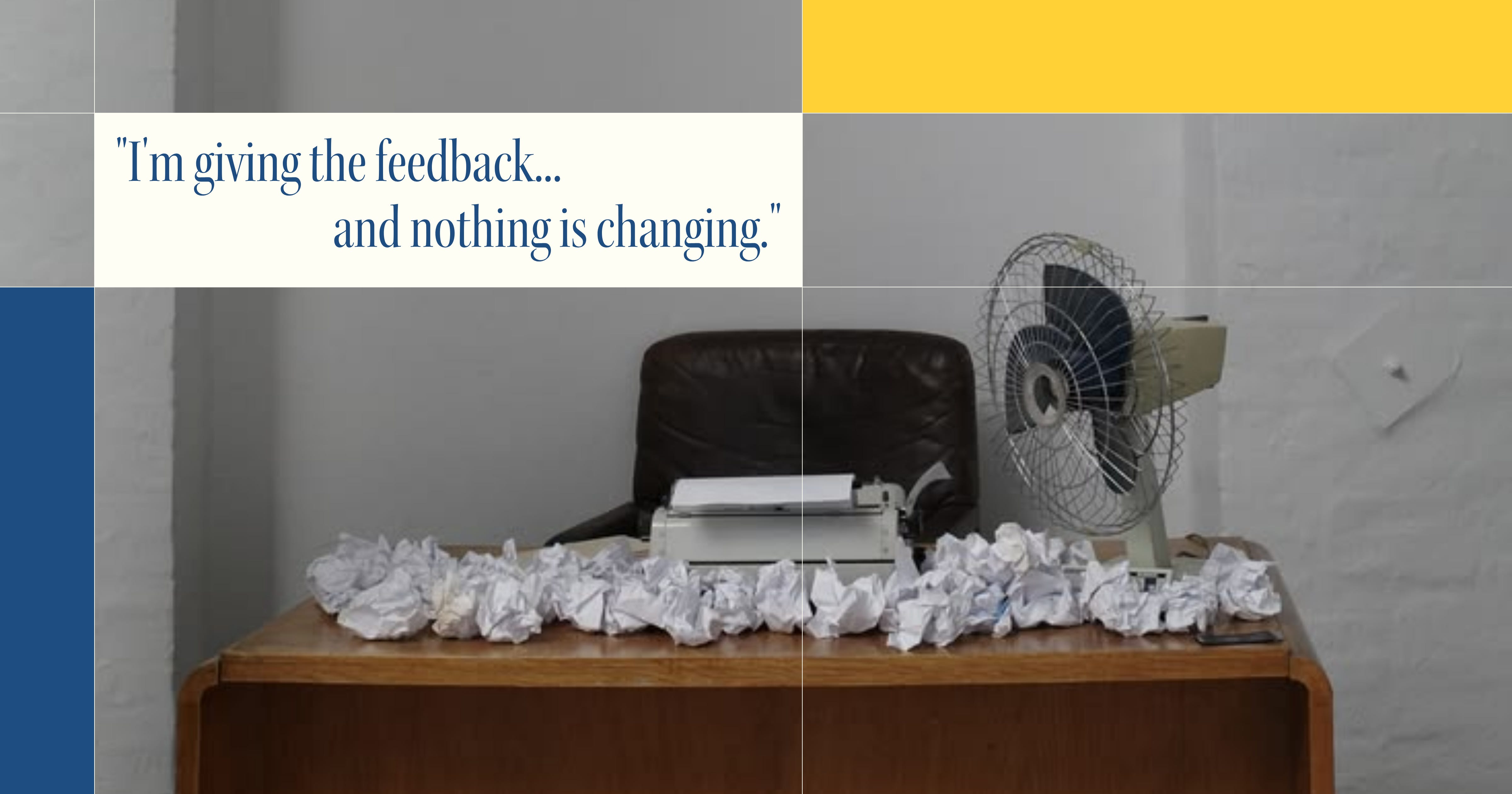
I’ve given them the feedback, so why isn’t anything changing?
This is a tension I’ve heard many times, and often the leader sharing it with me is equal parts frustrated and confounded.
It’s an easy moment to climb our ladder and start telling ourselves stories about our team member. They don’t care. They’re not listening. They’re not capable.
And while those things may sometimes be true, acting on those assumptions is a sure way to ensure nothing changes. When we believe someone isn’t capable or they don’t care, it often becomes a self-fulfilling prophecy. We continuously notice only behaviors that support those conclusions.
As leaders, instead of pointing the finger at our people, we want to first take stock of our own actions and approaches. It’s easy for us to feel like we’ve been incredibly clear, and that’s not always the case.
If you find yourself in this loop, here are four places I would look first (and the tool I’d apply):
1. Are we assuming understanding or actually confirming it?
I’ve found managers often think they’re on the same page with an employee after delivering their feedback, but in reality, what feels so obvious to them doesn’t translate.
At the end of the day, how effectively we’ve communicated isn’t proven by what we’ve said; it’s provided by what the other person is taking away. And it’s pretty uncommon for us to check the latter.
We assume we delivered the message (which makes perfect sense to us), so the person on the receiving end should be on the same page.
The Tool to Use: Mirroring
Instead of assuming alignment, ask them to mirror back what you’ve said. Or share their understanding of next steps.
What’s your takeaway from this conversation?
What are you planning to do differently moving forward?
Can you walk me through how you’re thinking about this?
When someone mirrors what we’ve said back, we get real information. It is the most true assessment of whether we’re actually aligned and our communication style is working.
2. How clear were we, really?
Ambiguity is the enemy of accountability. How clear were your expectations?
It’s easy to say things like "be more proactive" or "communicate better," and to us, that feels straightforward. But there is a lot to interpret there. Those directions leave miles of space for the other person to define success in a way that may not match what you had in mind.
So, when we go back later and feel like progress hasn’t been made, it becomes frustrating on both sides. We feel like we’ve been clear, and they feel like they’ve been trying.
The Tool to Use: Committed Action Language
What precisely needs to happen? By when?
The more concrete the expectation, the easier it becomes to follow through. Your teammate knows exactly what to do, and you know exactly when to follow up if something hasn’t happened.
No more waffling or wasting time/energy wondering if they’re working on it.
If you asked them for a weekly project update by EOD Wednesday, then you know you can follow up first thing Thursday morning if you haven’t seen anything. (If you just asked them to “be more communicative,” we’re living in a perpetual grey area.)
3. Have we actually communicated the impact?
It’s also common for us to be really frustrated by a situation, but when we go to deliver feedback, we default to keeping things light and acting like it isn’t too big a deal.
Now, I’m certainly not a proponent of jumping into a feedback conversation heated. But it’s a disservice to our people to downplay importance.
If we act like something is minor, we shouldn’t be surprised when it’s treated as such.
The Tool to Use: S.O.S. Feedback
Instead of bringing emotion into a conversation, I recommend focusing on clearly articulating the situation's impact.
Instead of: Can you just make sure this gets done earlier?
We can say: When this comes in late, I feel a lot of stress because I have to shift all my priorities around to pull everything together. And, in turn, it affects how prepared we are as a team.
We don’t need to bring stress into the conversation, but it’s incredibly helpful to share that you feel stress in those moments. That level of context humanizes the request and lends it the appropriate weight.
People are much more likely to change their behavior when they understand the real consequences of not doing something, rather than just the instruction itself.
4. What’s actually getting in the way?
If you’ve confirmed understanding, set a clear expectation, communicated the impact, and you’re still not seeing change, then we are likely no longer dealing with a communication issue.
There’s something else that’s blocking execution. And this is where it’s so easy to double down on making assumptions, when what’s actually needed is curiosity.
The Tool to Use: Perspective Taking
Instead of repeating the same directive, we can shift toward trying to understand what we don’t see.
We’ve talked about this a few times, and I’m not seeing the shift yet. What’s getting in the way?
What feels challenging about this for you?
What do you need support with to follow through?
If you were in my position, how would you handle this?
These questions do two things. Firstly, they help us uncover context we may not have. And secondly, they invite the other person into the problem-solving process, rather than keeping them in a passive role where they’re just being told what to do.
This requires a level of humility, because it means being willing to admit there may be something you don’t fully understand yet.
And sometimes there is. And sometimes there isn’t.
But regardless, you’re now working toward a solution together instead of continuing the same unproductive conversation.
The Shift
When nothing changes, it’s very easy to conclude that the other person is the problem. And again, sometimes that might be where you ultimately arrive.
But Elevaters take a moment and ask a different set of questions.
Have I actually ensured they understood what I was asking?
Was I as clear as I think I was?
Did I make the impact of this visible?
Have I gotten curious about what might be in the way?