
This week, during an Attention Management session with a fellow coach, we fell into a topic of conversation that has continued to stick with me for a few days: multitasking — and our very real belief that we’re good at it… and that it’s a skill worth bragging about.
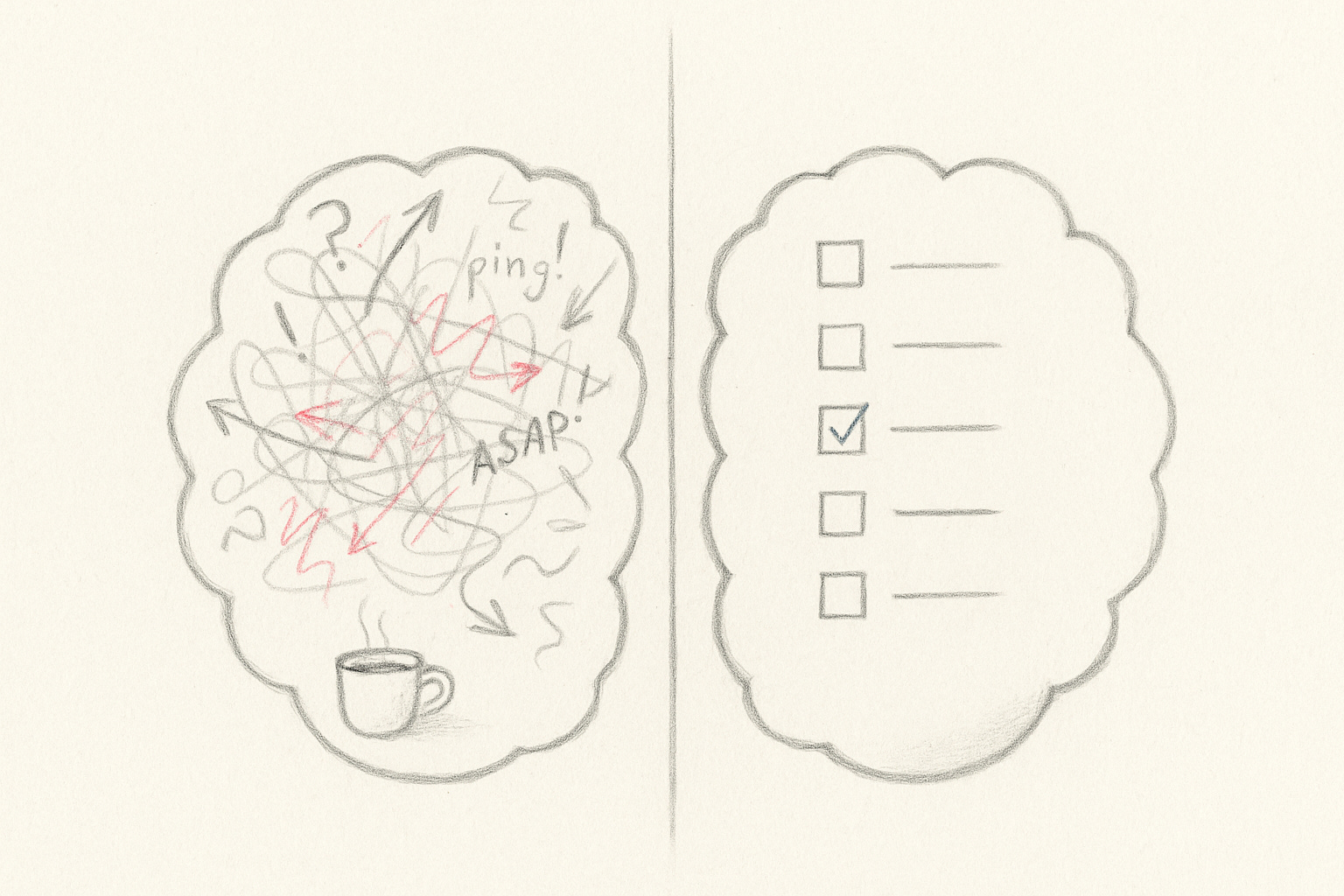
We’re not good at multitasking.
We think we are, but we’re not.
It’s not how the human brain is wired.
Every time we switch from one task to another, we lose time, we lose quality, and we dilute our attention. This isn’t a character flaw — it’s neuroscience. And yet, despite everything we know, “multitasking” still shows up on job descriptions as a desired skill.
In that conversation, I said what I’ve thought for years:
Multitasking shouldn’t be a qualification. Prioritizing should.
Because the truth is: the ability to prioritize — to intentionally choose what matters most — is a far more valuable leadership skill than juggling 15 things at half-speed.
The Productivity Mirage
Most of us are living in what Stephen Covey coined the “reactive zone.” We bounce from urgent thing to urgent thing. We maintain a to-do list that somehow never gets shorter. And we get the temporary high of checking boxes, even when nothing truly meaningful is moving forward.
I talk to leaders all the time who say some version of:
“I ran around all week, and I still don’t feel like I’m making progress.”
This isn’t an effort problem.
It’s a prioritization problem.
We can spend 40 hours a week doing things other people ask of us, and not move a single one of our big initiatives forward. And when that becomes the norm, we start believing that being “busy” is the same thing as being effective.
It’s not.
Prioritization Is One of the First Things We Teach for a Reason
In our Elevate program, prioritization is foundational. It’s one of the earliest modules because it fundamentally changes how people function day-to-day. Once someone learns to prioritize, everything else becomes easier: coaching conversations, strategic planning, even boundary-setting.
Prioritization is a discipline, but it’s also incredibly freeing.
We teach people to think about it across different time horizons:
Annual: What are my big rocks for the year?
Quarterly: What meaningfully moves the business forward?
Weekly: What five things would make this a successful week?
Daily: What is the highest-value thing I can do today?
At every level, the question is the same:
What is truly important — and what is simply loud?
The Weekly Practice That Changes Everything
One of the easiest places to start is weekly planning.
Sometime between Friday afternoon and Monday morning, ask yourself:
“If I accomplished five meaningful things this week, what would make me feel successful?”
Five.
Not fifteen.
Not a full page of tasks.
Five priorities that substantially move the ball forward.
Then, put them in your calendar.
Literally block the time.
This does two important things:
It removes the low-level anxiety of knowing you have important work to do and not knowing when it will happen.
It forces everything else to fit around your priorities, instead of your priorities squeezing into the leftover margins of your week.
And here’s the magic: they always fit. The small things will get handled. They always do. But only if the big things are planned first.
This Isn’t Just About Work
Every one of us plays multiple roles:
Leader. Partner. Parent. Friend. Volunteer. Teammate. Human with a body that requires sleep and movement and care.
Each role comes with its own priorities. Prioritization helps us see across them without drowning in them. The trap we fall into is turning these roles into never-ending to-do lists.
Prioritization is not about saying something won’t get done.
It’s about saying:
“Not everything gets to be first.”
This is how we build productive, sustainable lives — ones that don’t require us to sprint endlessly in response to what other people place on our plate.
Multitasking Is Reactive. Prioritizing Is Intentional.
Multitasking often shows up when we’re overwhelmed, rushed, or trying to keep our head above water. It’s reactive.
Prioritization is the opposite.
It is proactive.
It is thoughtful.
It creates clarity.
And clarity is what unlocks capacity.
A leader who prioritizes — who consciously chooses what gets their attention and why — has exponentially more impact than a leader who relies on multitasking as a strategy. One is driving; the other is being pulled.
The Unlocking Move
If there’s one shift I wish every leader could make, it’s this:
Plan your priorities first. Let everything else fall around them.
The difference in output, creativity, and stress levels is profound.
And if you’re reading this and thinking, I want to prioritize but I don’t know where to start, here’s the smallest, easiest entry point:
Pick your five things for the week.
Block the time.
Honor it like a meeting.
Do that enough weeks in a row, and your life starts to change.