

Not to alarm anyone, but we only have five holiday-free weeks left before the end of the year. If that did, in fact, alarm you, and you’re like me, your mind may have immediately begun rolling through the seemingly endless list of things that need to get accomplished before January.
It is these exact moments—moments of stress and pressure—that we can apply our toolkit. We can slow down, avoid reacting, and take thoughtful steps toward the outcome we really want.
For me, a successful outcome isn't just accomplishing my Q4 goals, but ensuring they’re done well and given adequate attention. I want to give myself space to iterate and refine. Work through things while there is time to spare and be creative, rather than scrambling, missing details, or letting priorities fall by the wayside.
And the tool that came to mind the moment I realized it was already the first week of November: The Eisenhower Matrix.
The Eisenhower Matrix
The Eisenhower Matrix provides us with a visual framework for understanding how we’re spending our time. Everything we do falls into one of these quadrants.
Everything is urgent (or not) and important (or not).
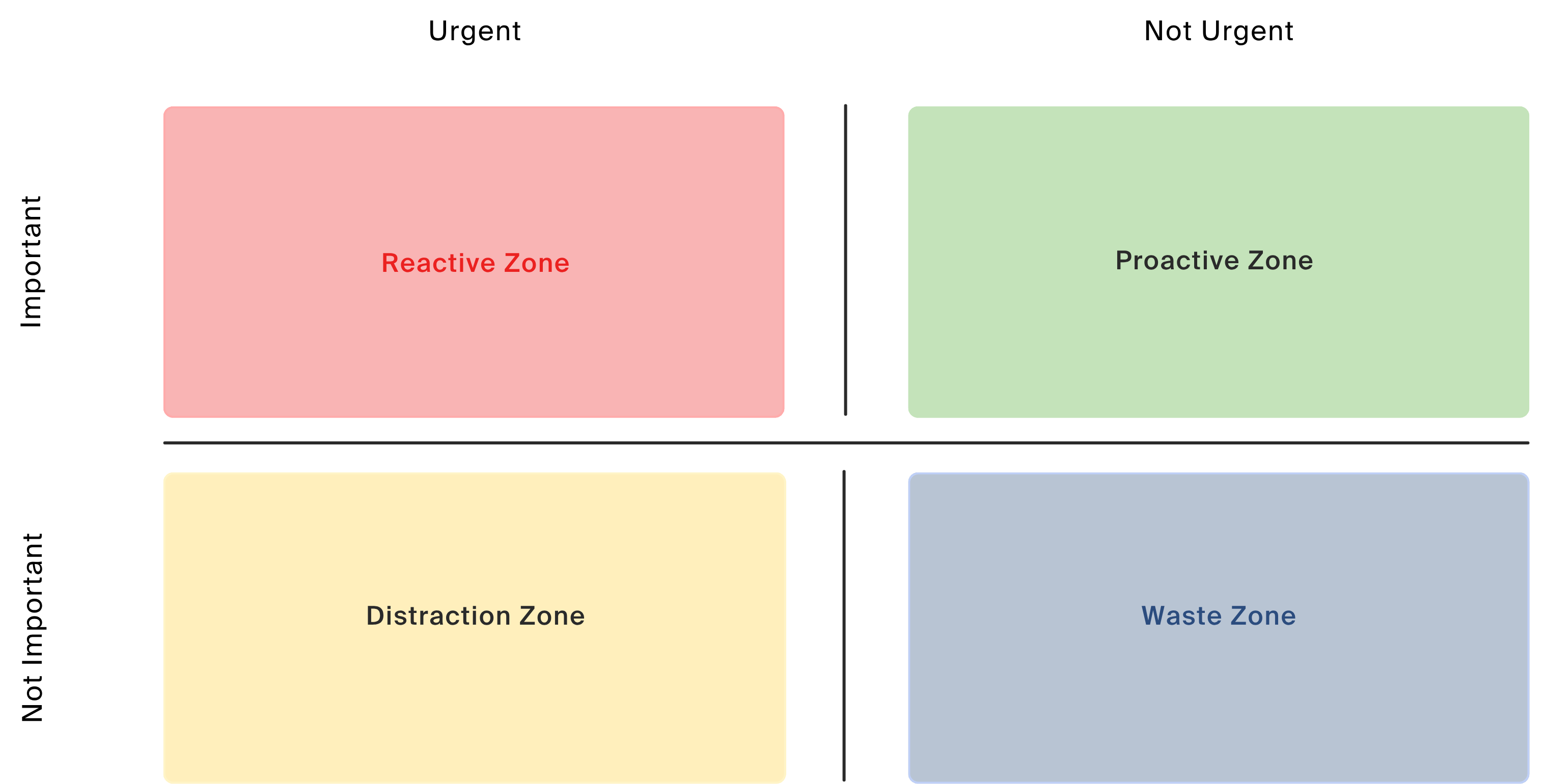
I could write 1,000 words on each quadrant, but I’ll spare you. Instead, here is the relationship that I think is most important to internalize on November 6th: every minute we spend in the Distraction Zone is a minute we don’t spend in the Proactive Zone.
Why focus on the Distraction Zone?
This is the quadrant that bleeds most of our bandwidth. We get caught up in the immediacy of the request, and don’t take time to decide if it’s actually a high impact priority. Stagen estimates that the average manager spends 5-15 hours a week in the Distraction Zone. Maybe some of these examples are relatable:
Pings and notifications
An email notification popping up mid-task, and you click it “just to see”
A text that buzzes during a one-on-one, and you glance at your phone
Other people’s urgency
Someone stopping by your desk with something that’s urgent to them but not to you
A meeting invite added last minute that you reflexively accept
Self-made interruptions
Remembering a small errand mid-task and stopping to do it right then
Answering a request immediately because it’s quick, even though it breaks your flow
These might seem like small examples, but the compounding effect is disruptive. The notification may only take a second to look at, but now you’re on your phone and all of a sudden you’ve lost 15 minutes without even realizing it. Your colleague's “quick Slack message” turns into a 45-minute rescue operation.
So, how do we combat the Distraction Zone? By planning ahead and creating boundaries.
Most of the examples above are completely avoidable with a little intentionality.
Silence your notifications
Put your phone on Do Not Disturb
Set your Slack status to “unavailable”
Let your team know you are heading into a time block for the next hour
Check in with team members proactively at the beginning of the week or day to see if they anticipate needing your support
The Gift of the Proactive Zone
It’s always amazing to me how much I can get accomplished when I set aside uninterrupted time to tackle a big project. When we make that space, we give ourselves the chance to get into flow and make real progress. If we allow for distractions, that flow never materializes. We spend more time and get less done.
Those Proactive Zone moments when we’re locked in and excited about the work we’re doing are actually energizing. In contrast, if we have to do the same work with our back against the wall at the end of the year, or we’re constantly being interrupted, it can feel draining and frustrating.
So, for the sacred stretch of time we have between now and the end of the year, block your Proactive Zone hours, and protect them like a client meeting.
It will not only allow you to accomplish your work, but you’ll head into the holidays with the time and attention for everything else that matters.