

Most of us know what it feels like to be unheard. You share an idea in a meeting and it’s instantly dismissed, or the conversation moves on as if you hadn’t spoken, or you explain something carefully and walk away sure it didn’t land. It’s deeply frustrating, and over time it wears down trust and the relationships built on it.
That’s because listening is a form of caring. When someone really listens, it tells us they’re interested in more than their own agenda, and that what we see, understand, and need matters to them too.
On a team, the stakes are even higher. Listening is an essential ingredient in real commitment and buy-in. When leaders simply tell, without giving people room to challenge or ask questions, they often get surface-level agreement that masks uncertainty, anxiety, or confusion.
So, what are our options when we’re the ones feeling unheard?
Option 1: Lead By Example
When I reflect on moments when I felt dismissed or unheard, frustration dominated my internal narrative. I would hear someone delivering a message and think:
“They don’t understand.”
“They aren’t paying attention.”
“They’re missing the point.”
And when I hold the mirror up, I realize that I wasn’t listening in those moments. I was doing precisely what I was accusing them of.
I was making assumptions, jumping to conclusions. I certainly wasn’t focused on deeply understanding them or how they arrived at their conclusions. I was right, and they weren’t getting it.
And as we often talk about in the Elevate Program, this toolkit is for us. It’s tempting to point a finger and tell others what tools they ought to use, but the deeper, more rewarding, more impactful work is changing our approach.
Active listening and perspective taking are two of my favorite tools. In large part because it only takes one person to shift a conversation. When we lean into active listening, show up with genuine curiosity, and think deeply about the questions we can ask to better understand the person opposite us, walls start to come down.
When we feel understood, our capacity to understand others grows. And it works both ways: when we take the time to understand others, their capacity to understand us grows too.
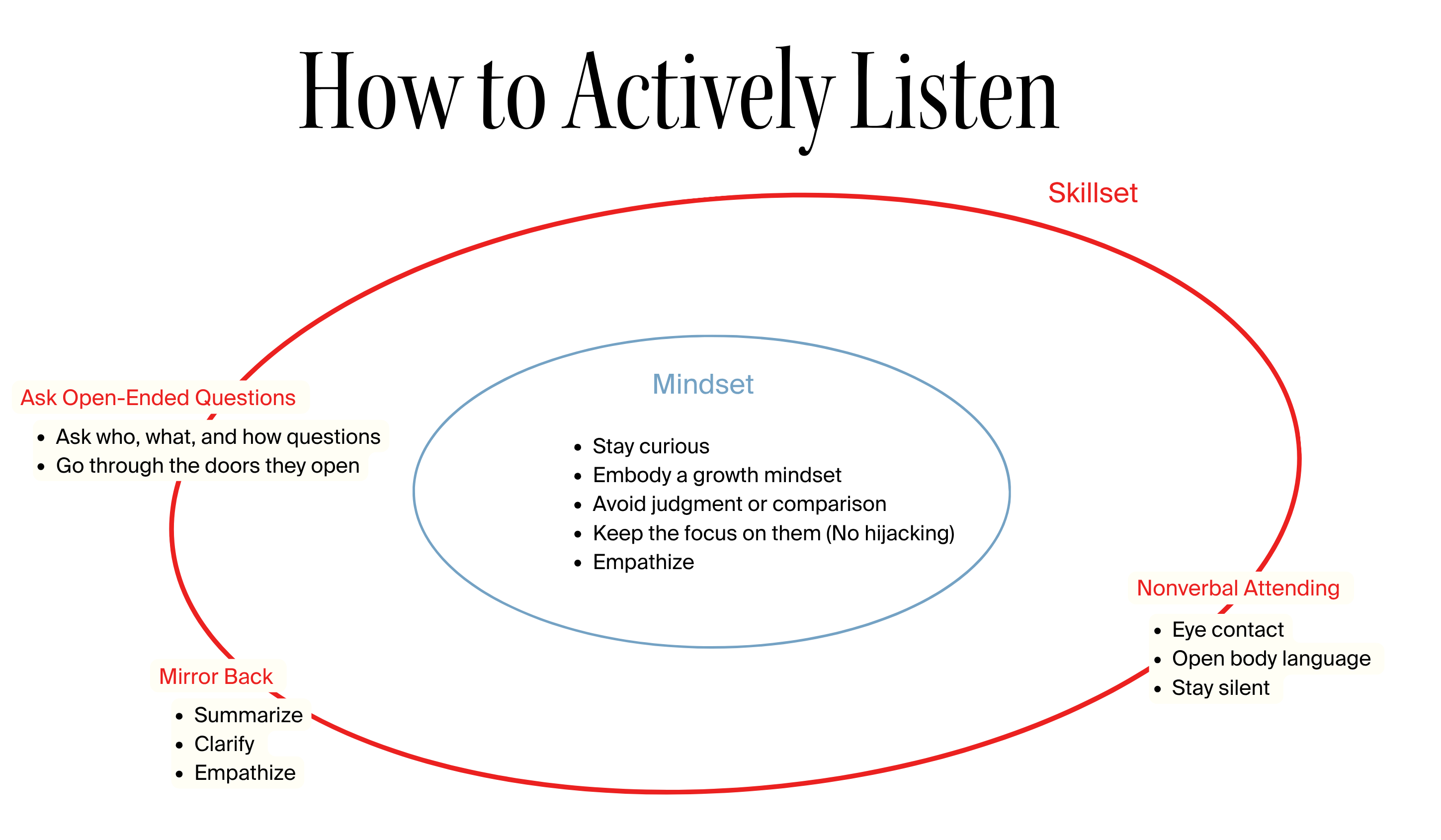
So, in moments of frustration, what questions can you ask? How can you lean in? What information do you not know or understand, and how can you find out?
That deeper understanding not only connects you more with the other party, but also makes you a stronger communicator when you share your piece, because now you understand their thought process, what’s driving their decisions, and what they value most.
Option 2: Share Your Experience and Own Your Part
Now that we’ve held up the mirror (elevating ourselves), we can elevate those around us. Being willing to reflect and own our part doesn’t mean we forgo the opportunity to share our perspective.
One of the greatest gifts we can share with others is our experience. If we say nothing, we can’t expect anything to change.
The key to elevating others lies in both our intent and our approach.
Our intent is to help build others’ self-awareness. Help them understand something they can never experience firsthand. Our perspective is a gift. (If our intent is to “be right” or blame, we’re slipping into persecutor territory.)
Our most effective approach involves both humility and clarity. Humility about our gaps and recommitments, and clarity around the impact and our values.
In Dare to Lead, Brené Brown shares the Engaged Feedback Checklist—a list of things to consider to determine whether we’re ready to have a difficult conversation. One of my favorite considerations: I am open to owning my part.
Owning your part looks exactly like what we talked about above. And I think it’s so powerful to bring that ownership directly into a feedback conversation. Consider the difference between these two approaches:
In yesterday’s strategy meeting, I began sharing my perspective about how I believe the budget should be allocated, and you moved on without acknowledging it. I felt frustrated and would really appreciate seeing my thoughts taken into consideration.
versus
In yesterday’s strategy meeting, I began sharing my perspective about how I believe the budget should be allocated, and you moved on without acknowledging it. I left the meeting feeling deeply frustrated, and as I reflected, I realized that not only did I feel unheard, but I also wasn’t doing my best to hear and understand your perspective. I’d love to work together to make sure we both prioritize hearing and understanding each other. Moving forward, I’m committed to listening and asking better questions before I jump to conclusions. Could you commit to the same?
The first piece of feedback is great. The second is even better. Ownership is an unlocking move, especially in difficult moments.
Just as our ability to listen opens up others' capacity to listen, our ability to take ownership and make adjustments opens up others' capacity to do the same.
This is why leading by example is a core tenet of the Elevate Program. That’s where our power lies.