

I’ve been teaching and using the Elevate toolkit for almost a decade now. And there’s one thing I will never stop saying—mostly because I keep needing to hear it myself:
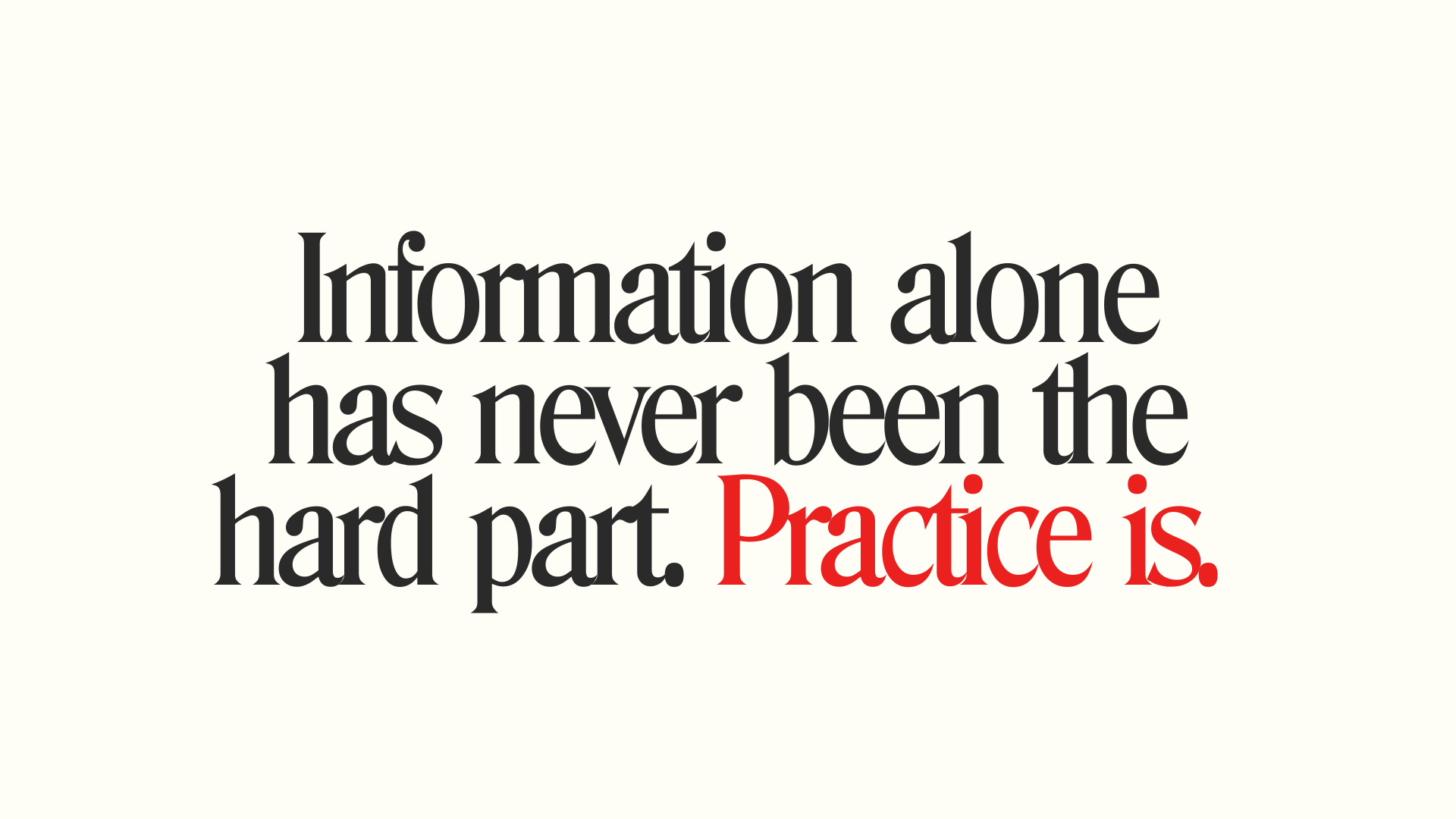
Information alone has never been the hard part. Practice is.
One of the biggest blessings of my job is that I’m sitting in these tools all day, every day. I’m teaching them. I’m training them. I’m reminding other people how and why they work. And because of that, I get constantly reminded of the practices that help me show up in the best way.
And still, I don’t use them perfectly.
I don’t use them all the time.
I’m not “done.”
Which feels important to say, because if after ten years of doing this work I still need reminders, still slip, still have to recalibrate… that’s not a failure of the tools. That’s just being human.
What it does remind me of, over and over again, is how valuable it is to keep this stuff front of mind. To stay sharp. To return to the basics.
Because the gap between knowing and doing doesn’t magically disappear with experience. If anything, it just gets sneakier.
January has been a blur.
I cannot believe it’s already the 27th. January is usually slow and stretchy and quiet. This one? It moved fast. And I came into the year with a lot of new things on my plate—new priorities, new responsibilities, more people depending on me than even a few months ago.
Different season. Same human.
And what I’ve been reminded of recently is this: when things speed up, when complexity increases, when your world expands—the answer for me is almost never to add more tools. It’s to go back to first principles.
Not reinventing the wheel.
Just returning to what already works.
Last week, I had what feels like a very small win, but it felt enormous.
On my weekly call with my coaches, I realized it was the first week where I had actually delivered everything I said I would deliver, when I said I would deliver it.
That sounds… painfully basic. Almost embarrassing to write.
But it mattered.
For a few weeks before that, I had been trying to “get it right.” Playing with my schedule. Blocking time. Underestimating how long things actually took. Overcommitting. Adjusting. Missing. Adjusting again.
And then last week, something clicked.
I finally found the time block that was realistic. Sustainable. The one I could actually protect every week. I figured out how much time I truly needed—not the aspirational version, the real one.
And the difference was immediate.
I felt lighter.
Clearer.
More grounded.
There was no static in the background of my brain. No low-grade anxiety about the things I knew I owed people. No feeling like I was quietly letting someone down.
I was on my front foot.
And honestly? That feeling was exhilarating.
I think it’s easy to dismiss moments like that as “low-hanging fruit.” Of course you should do the things you say you’re going to do. Of course you should be reliable. Of course.
But here’s the thing: simple doesn’t mean easy.
Even when you’ve been doing this work for years.
Even when you know the tools.
Even when you understand the theory.
It still takes trial and error.
It still takes adjustment.
It still takes grace.
The first couple weeks of January weren’t perfect. I planned. I missed. I didn’t leave enough time. I wasn’t efficient in the way I approached things. And instead of making that mean something about me, I tried to stay curious.
What’s the delta?
What can I learn?
What do I do differently next week?
That mindset—that willingness to adjust instead of judge—is everything.
Something I see a lot (and feel myself, too) is this quiet pressure to do all the things. Especially if you’ve been exposed to a lot of tools, frameworks, and practices.
It can start to feel like growth means doing everything at once.
It doesn’t.
In my experience, you will always get more benefit from choosing one thing and committing to it fully than trying to half-do ten things at the same time.
One tool.
One focus.
One experiment.
Not forever. Just for now.
And letting yourself be imperfect as you figure it out.
What I don’t think we talk about enough is the trust you build with yourself when you start showing up the way you said you would.
That trust compounds.
It makes you more confident as a teammate.
More reliable as a leader.
Kinder to yourself as a human.
And it makes everything feel lighter.
Last week wasn’t about perfection. It was about alignment. It was about finding a rhythm that allowed me to show up for my team, for my coaches, and for myself—all at the same time.
This week, I’m holding onto that feeling.
Not because I expect it to look exactly the same.
But because I know what’s possible when I return to the fundamentals, stay growth-minded, and let the tools meet me where I actually am.
The circumstances will keep changing.
The tools will keep becoming relevant in new ways.
And the work—human development—will never be about perfection.
It’s about reflection.
Adjustment.
Trust.
And continuing to elevate: one intentional choice at a time.